We make AI visibility measurable
The Findori Visibility Framework shows how visible your organisation really is in answers from OpenAI, Gemini, Claude and Perplexity. Not based on one occasional question, but through a fixed, checkable measurement across four models, 24 prompts and four measurement days.
Measuring AI visibility looks simpler than it is
One good result doesn't mean you're visible
Ask ChatGPT about your market once, and your company might get mentioned. Ask the same question again tomorrow, and the answer can be different.
That makes a single prompt interesting, but not yet a reliable measurement.
Many AI visibility tools only count how often a name appears. They don't tell you whether the company is actually recommended, how prominently it appears in the answer, or which sources the model relies on.
That wasn't enough for us.
When we advise clients on where to invest their time and money, we want to be able to explain what that advice is based on. So we built our own measurement standard.
No gut feeling. No secret algorithm. Just demonstrable evidence.
AI visibility is a new field. There's no universal equivalent yet of positions one, two and three in Google.
Yet scores are being handed out everywhere.
The problem is that with many of those scores, you can't see how they were arrived at. Which questions were asked? How often was it measured? Which models were used? When does something count as a recommendation? And how much weight does one chance answer carry in the final result?
We felt a client is entitled to know that.
That's why the Findori Visibility Framework is built around one principle:
Every score must be explainable and traceable back to the original evidence.
You can see which question was asked, which AI model answered, whether your brand was mentioned, how it was presented and which sources were used.
That makes the result not just measurable, but usable.
From a vague topic to a manageable result
The Findori Visibility Framework is our distinctive method for measuring AI visibility. It combines four things that are usually looked at separately.
- visibility across four AI models
- different moments in the buying process
- multiple measurements spread across different days
- human review wherever automated rules don't offer enough certainty
As a result, we don't just measure whether your name appears somewhere. We look at what position your brand gets within the answer, and where you're losing visibility.
That difference matters. Being mentioned is nice. Being recommended is far more valuable commercially.
We don't just measure whether you're visible, but how
The Findori AI Visibility Score consists of four separate components. Each component has a fixed, published weighting.
Mention
Is your organisation mentioned in a relevant AI answer?
This is the foundation. If someone asks about providers, solutions or experts in your market, your name needs to show up at all.
We measure this across the full set of prompts and models. That way we can see whether you're structurally recognised, or only appear for a handful of chance questions.
Recommendation
Is your organisation just mentioned, or actually recommended as a suitable choice?
A brand name in a long list is worth less than a clear recommendation with a reason why that organisation is a good fit.
That's why we distinguish between appearing and being chosen.
Prominence
How visible is your organisation within the answer?
A brand discussed first and at length holds a different position than one mentioned briefly at the bottom.
So we look at the position, emphasis and context of the mention.
Own-source citation
Does the AI model use your own website as a source?
A reference to your own domain shows that your website isn't just findable, but actually used as a source of information.
That matters, because it gives you more influence over the facts, explanations and arguments that end up in the answer.
You don't have to take our word for it
We don't change the weighting per client, and we don't add a hidden judgement call to make the outcome look better.
Share of voice is also kept separate. We use it to compare your brand with pre-agreed competitors, but that competitive position never quietly changes the main score.
That way it stays clear what we measure, and why your score rises or falls.
Not one clever prompt, but 384 comparable observations
For an official AI visibility audit, we use a fixed measurement setup.
24 research questions
We ask 24 questions tailored to your market and your customers' buying process. Those questions are spread across six intents:
- discovery
- problem and need
- comparison
- purchase
- authority and trust
- source research
That way we measure not just whether someone already knows your name, but also whether you show up while a prospective customer is still deciding.
Multiple AI models
We measure the answers from:
- OpenAI
- Gemini
- Claude
- Perplexity
No model uses exactly the same sources, or phrases every answer the same way. By using four models, we avoid letting one system determine the full picture.
Measurements spread across several days
AI answers can vary from one moment to the next. That's why we spread the audit across four separate days.
Human review
Automated rules can classify a lot, but language isn't always black and white.
When it isn't clear enough whether an answer really counts as a recommendation, or how prominently a brand is presented, the answer goes to human review. We don't let doubt quietly disappear into an algorithm.
A far sturdier basis than one batch of screenshots taken in a single afternoon.
Measuring isn't enough. You need to be able to explain what's happening.
The distinction isn't in one isolated formula. It's in the combination of fixed measurement conditions, four AI models, commercial query intents, human review and full supporting evidence.
Transparent
Every score can be traced back to the questions, answers, sources and scoring rules.
Repeatable
We can run the same measurement setup again later. That way you see not just where you stand, but whether your position genuinely changes.
Commercially relevant
We measure questions tied to discovery, comparison and purchase. Not just technical visibility, but the moments when a prospective customer is preparing to choose.
Comparable
Your visibility is compared with relevant competitors within the same answers.
Not dependent on one model
The outcome isn't determined by one AI platform or one favourable prompt.
Focused on action
The report doesn't stop at a score. Every key finding is translated into a priority, quick wins and a plan for the first ninety days.
Not every measurement needs to be a full audit
For a first indication, we can run a limited snapshot. A snapshot shows whether there's reason for further investigation. It's useful for a quick read on the situation, but it doesn't receive an official Findori AI Visibility Score. A full audit goes further.
| Snapshot | Full audit |
|---|---|
| A limited set of questions | 24 fixed research questions |
| One limited measurement moment | Measurements spread across several days |
| A first indication | 384 comparable observations |
| No official score | A full AI Visibility Score |
| Flags opportunities | Substantiates decisions |
| A concise result | Advisory report and 90-day plan |
Snapshots flag. Audits prove.
Not a dashboard where you have to draw your own conclusions
- how often your organisation is mentioned
- how often you're actually recommended
- how prominently you appear in answers
- how often your own website is used as a source
- what differences exist between AI models
- which customer questions you're visible for
- where competitors are chosen more often
- which content and evidence already work well
- where you're losing the most visibility
- which improvements deserve attention first
You don't just get the conclusions. The full measurement results are included as supporting evidence, so you can check what the advice is based on.
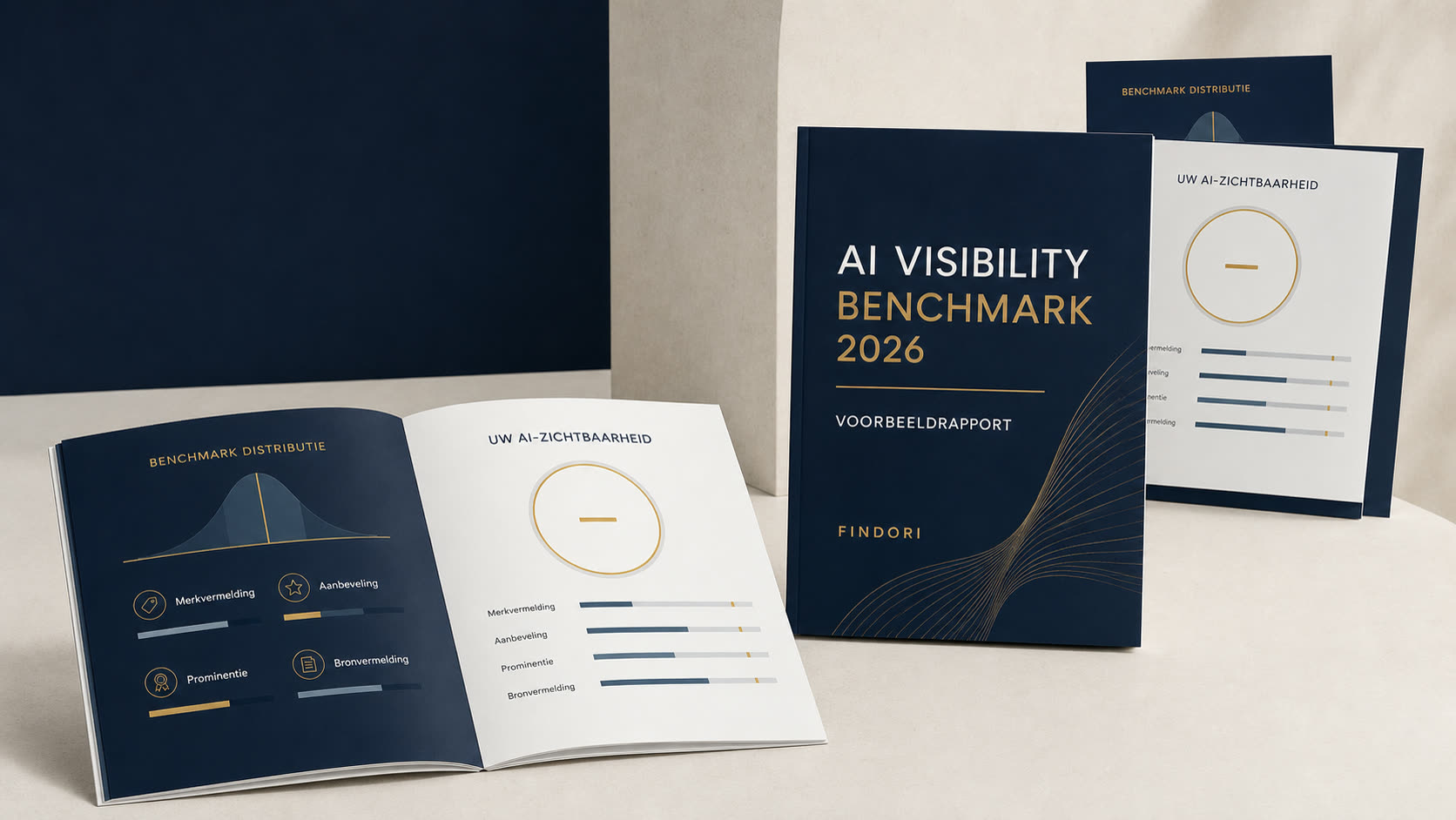 Preview of an AI Visibility Benchmark report
A score is the start, not the finish
An AI Visibility Score is only valuable once you know what to do with it. That's why we combine the framework with research into your website, content, technology, structure and online authority.
We don't just establish that you're less visible than a competitor. We look into why that's happening and which improvements are likely to make the most difference. After implementation, we measure again under the same conditions.
This way you don't end up with a scattering of separate GEO activities, but a clear cycle. That's how AI visibility becomes something you can steer.
Not sure whether AI already sees your business?
With the Findori AI visibility audit, you'll see in black and white how your organisation is mentioned, how your position compares with competitors, and where the biggest opportunities lie.
What you probably want to know
Can you guarantee that AI will recommend my business?+
No. Nobody can determine which company an AI model mentions in every answer. What we can do is measure what your current position looks like and work specifically on the signals AI answers are based on.
Is the score exactly the same every day?+
No. AI answers can change. That's why we don't base an official audit on a single moment, but on four models, 24 prompts and four measurement days.
Do you only measure ChatGPT?+
No. We test OpenAI, Gemini, Claude and Perplexity, so the outcome doesn't depend on a single AI model.
Why do you use human review?+
A recommendation isn't always recognisable in a single word. Human review prevents ambiguous phrasing from automatically being counted as positive or negative.
Is the AI Visibility Score the same as traffic or revenue?+
No. The score measures your visibility and position within the fixed set of research questions. Website visits, enquiries and revenue are separate outcomes and are measured independently.
Can I have the score measured again later?+
Yes. That's actually a key part of the framework. By reusing the same measurement setup, we can assess changes under comparable conditions.
Why doesn't a free check get an official score?+
A limited check doesn't contain enough measurement moments for a reliable overall score. It's meant to flag opportunities, not to replace a full audit.